Introducing Assumption Killer: Evidence-Based Validation for Every Assumption
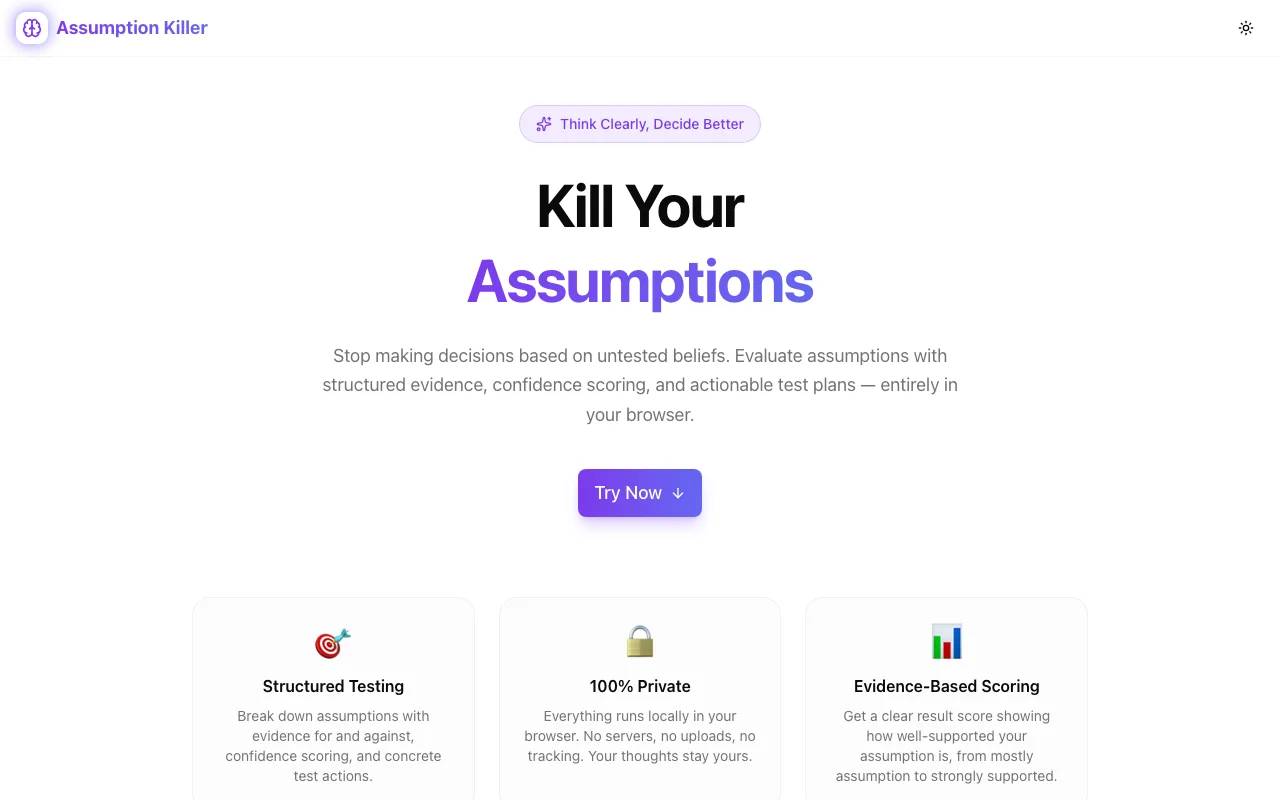
Assumption Killer is a free browser tool that turns vague beliefs into structured evidence analysis. Add evidence, score confidence, and find out whether your assumption actually holds up.
Introducing Assumption Killer: Evidence-Based Validation for Every Assumption
Every project has a graveyard of assumptions nobody questioned.
"The user wants this." "The market is big enough." "That won't be a bottleneck." These beliefs drive decisions, allocate engineering time, and justify roadmaps — often without a single data point to back them up. The cost shows up months later when something that "should have worked" doesn't, and you can trace the failure back to an assumption that felt too obvious to test.
Assumption Killer is a free, browser-based tool that forces assumptions into a structured evaluation. You name the assumption, add your evidence, score your confidence in each piece, and the tool tells you whether the belief holds.
The Problem It Solves
Teams don't skip assumption validation because they think it's unimportant. They skip it because the process is awkward. There's no standard format, no shared language, and formalizing it feels like it slows you down more than the assumption itself.
Assumption Killer makes it fast. The entire flow takes minutes, not meetings.
How It Works
Name the assumption precisely. Vague assumptions are hard to kill. "Users want better onboarding" can't be evaluated. "New users in our free tier churn within 7 days because they don't reach the activation event" can. The clearer the assumption, the more useful the evaluation.
Add evidence. Each piece of evidence gets tagged as supporting or contradicting the assumption. Evidence can be anything: a user quote, an A/B test result, a market research finding, a competing product's behavior, a failed experiment.
Score confidence. Not all evidence is equal. A comment from one user in a Slack DM scores low. A statistically significant survey of 200 target customers scores high. Assign a confidence score to each item.
Read the verdict. The tool surfaces an overall confidence level for the assumption — validated, invalidated, or uncertain — based on the weight and direction of your evidence. You can see immediately whether you have enough signal to act on the assumption or whether you need more data.
Everything runs locally in your browser. Your assumptions, your evidence, your strategic thinking — none of it leaves your machine.
When to Use It
Before committing to a feature. You're three sprints away from shipping something major. The business case rests on two or three assumptions. Ten minutes in Assumption Killer tells you whether those assumptions are backed by evidence or by wishful thinking.
After a discovery interview round. You talked to ten users. Some things they said confirmed what you expected. Others contradicted it. Assumption Killer gives you a structured place to process the signal before you decide what to build.
When you're stuck in a disagreement. Two people on the team have different beliefs about user behavior. Instead of cycling through the same arguments, document both positions as assumptions, add the available evidence, and score it. The tool makes the underlying disagreement visible and structured.
Post-mortem analysis. Something didn't work. Before moving on, use Assumption Killer to map the assumptions that drove the decision and evaluate which ones were wrong and why. It's the fastest way to turn a failure into a transferable lesson.
During technical design reviews. "This will be fast enough." "Users won't hit this limit." "We can refactor this later." Engineering decisions are full of assumptions. Surfacing them explicitly, even briefly, catches the ones that are actually risky.
What It's Not
Assumption Killer isn't a project management tool, a research repository, or a survey platform. It's a fast-cycle thinking tool for structured assumption evaluation. Use it before you commit, not after you've built.
Try It
assumption-killer.jagodana.com
Name your assumption. Add your evidence. Find out if you actually know what you think you know.
Part of Our Free Decision-Making Tools Suite
Assumption Killer is part of a growing collection of free, privacy-first tools for clearer thinking and better engineering decisions:
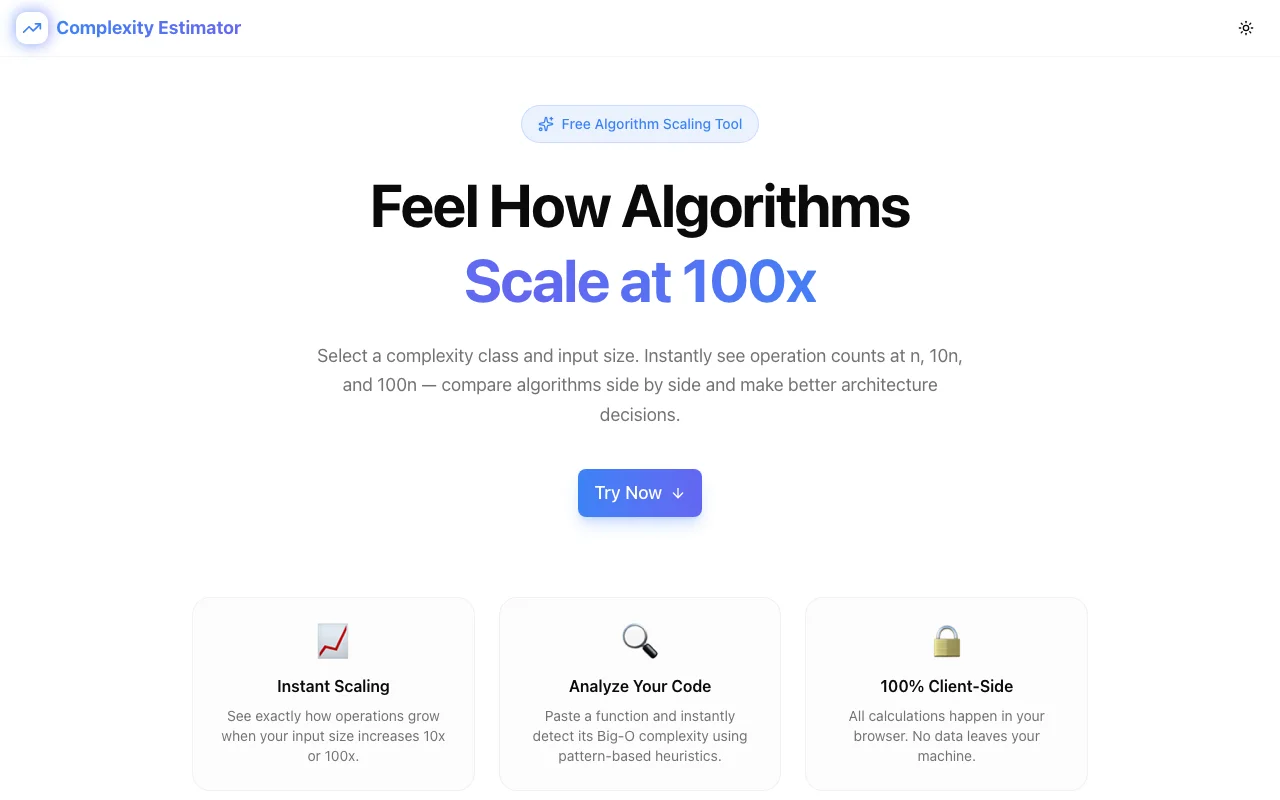
- Complexity Estimator — Turn Big-O notation into real operation counts. Stop guessing whether your algorithm scales.
- Latency Budget Calculator — Model end-to-end microservice latency against your SLA before you build.
- Decision Splitter — Weighted multi-criteria decision analysis. Score your options against what actually matters.
- Distraction Cost — Calculate the real productivity cost of workplace interruptions.
- Meeting Mirror — Reflect on your meeting habits. Identify patterns, reduce friction.
All tools run entirely in the browser. No accounts. No tracking. No server-side processing.