Back to Projects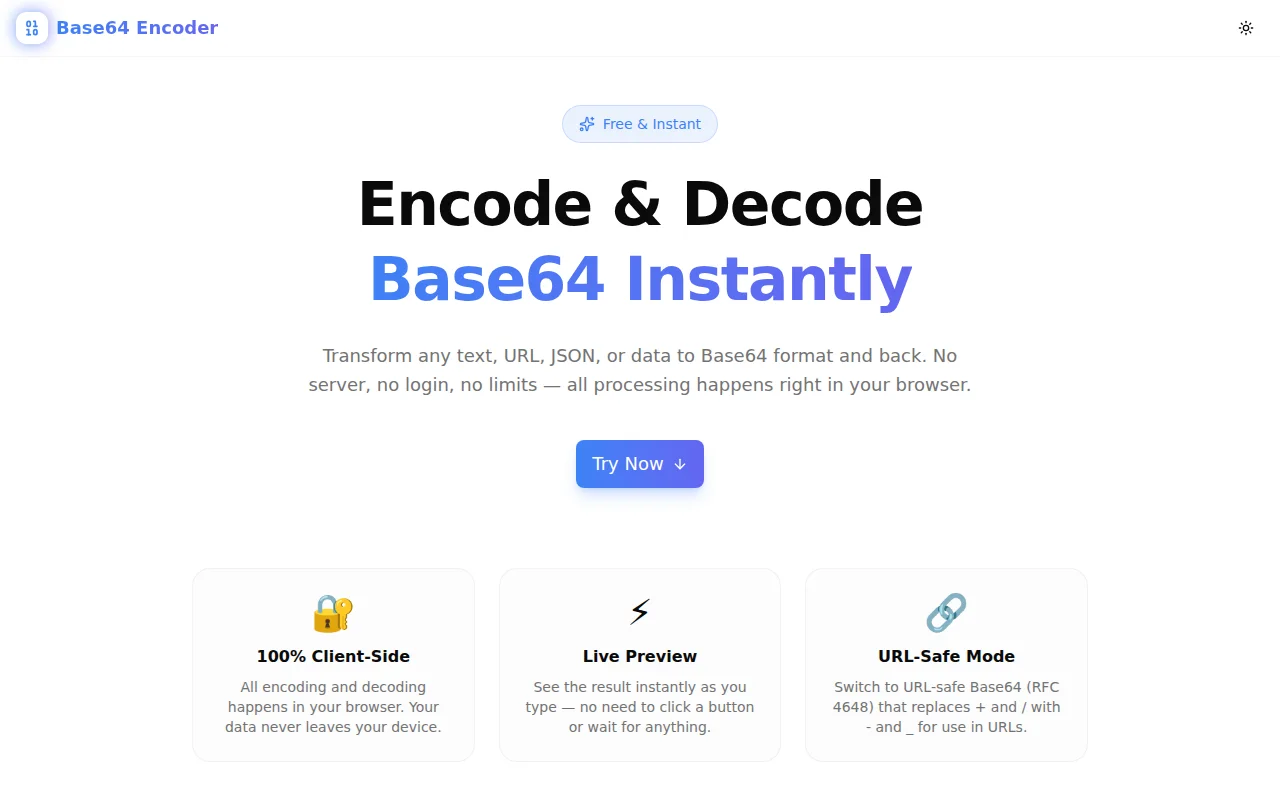
Developer ToolsFeatured
Base64 Encoder
A free online Base64 encoder and decoder that converts any text, URL, or JSON to Base64 format and back — live as you type, with URL-safe mode, 100% client-side, no data ever sent to a server.
Base64EncodingDeveloper ToolsSecurityNext.jsTypeScript
Start Similar ProjectAbout the Project
Base64 Encoder — Free Online Encode & Decode Tool
Base64 Encoder is a free, browser-based tool that converts any text, URL, JSON, or string to Base64 format and decodes Base64 back to plain text. Everything happens live as you type, with no button to press, no server to call, and no data ever leaving your browser.
The Problem
Developers encounter Base64 constantly: embedding credentials in HTTP headers, encoding JWT payloads, storing binary data in JSON, passing parameters through URLs, or reading error messages from APIs. The encoding is trivial in theory — 64 printable ASCII characters representing any binary data — but reaching for a terminal or memorising the exact command (echo -n "..." | base64) slows you down every time.
Copy-pasting into a random online tool raises a different concern: you're sending potentially sensitive data — API keys, tokens, internal strings — to a third-party server that logs request bodies. For a tool this simple, that risk is unnecessary.
How It Works
Live Encode / Decode Toggle
Switch between Encode and Decode mode with a single click. The output updates instantly as you type — no submit button, no round-trip to a server. Encode converts your text to Base64; Decode converts a Base64 string back to readable text. The mode label updates the placeholder text so context is always clear.
URL-Safe Base64 (RFC 4648 §5)
Standard Base64 uses + and /, which are URL-reserved characters. Passing standard Base64 in a query string or path segment requires percent-encoding, which bloats the string and breaks readability. URL-safe Base64 replaces + with - and / with _, producing a string that travels through URLs without escaping. Toggle URL-safe mode with a single switch — the output updates immediately.
Swap Input ↔ Output
After encoding, one click loads the result back into the input and flips to Decode mode, ready to round-trip the data. This is useful for verifying that the encoded value decodes back correctly.
Copy to Clipboard
A one-click copy button copies the output to the clipboard with a success toast. No selecting, no right-clicking, no triple-clicking inside a read-only field.
Error Handling
Invalid Base64 strings (wrong characters, bad padding) produce a clear error message in the output area instead of silently returning an empty or garbled result. The error state is visually distinct — red border, red text — so you notice it immediately.
Key Features
- Live output — result updates as you type, no button press required
- Encode and decode — both directions in the same tool
- URL-safe mode — RFC 4648 §5 with
-and_instead of+and/ - Swap mode — flip input and output with one click for round-trip verification
- Copy button — one click to clipboard with sonner toast confirmation
- Error states — clear feedback for invalid Base64 input
- Character count — shows input and output length, plus output-to-input ratio for encode mode
- 100% client-side — no data transmitted, no server involved
Technical Implementation
Built on Next.js 16 with the App Router, TypeScript in strict mode, shadcn/ui components, Tailwind CSS v4, and framer-motion for entrance animations.
The encoding and decoding use the browser's built-in btoa() and atob() functions, wrapped in a small utility that handles:
- UTF-8 encoding —
btoa()only accepts ASCII; the wrapper usesencodeURIComponent+unescapeto correctly handle multi-byte Unicode characters before encoding - URL-safe substitution — a single string
.replace()pair after encoding, and the inverse before decoding - Padding normalisation —
atob()requires padding=characters to be present; the decoder adds them when missing, which is common with URL-safe Base64 transmitted in APIs - Error boundary — the utility catches any exception from
atob()(malformed input) and returns an empty string, which triggers the error state in the UI
The toggle, swap, and copy logic are all useCallback-memoised React handlers. The URL-safe state is a boolean flag. The output is derived state — a pure function of (input, mode, urlSafe) — so there is no output state to sync.
Use Cases
API Authentication
HTTP Basic Auth and Bearer tokens often encode credentials or tokens in Base64. Decode a suspicious Authorization header, verify a JWT's header and payload without a secret, or encode a username:password pair for a Basic Auth test.
Authorization: Basic dXNlcjpwYXNzd29yZA==
Paste dXNlcjpwYXNzd29yZA== into the decoder to see user:password immediately.
Data URIs
HTML and CSS support inline data using the data: URI scheme with Base64-encoded content. Embedding a small SVG icon, a loading spinner, or a tiny PNG directly in a stylesheet eliminates an HTTP request:
background-image: url("data:image/svg+xml;base64,PHN2ZyB4bWxucz...");Encode the SVG source once, paste the result into the CSS, done.
API Payload Debugging
REST and GraphQL APIs sometimes Base64-encode fields to safely transport binary or non-ASCII content in JSON. Paste the encoded field value into the decoder to see the original content without writing any code.
Environment Variables and Secrets
Some deployment platforms encode secrets in Base64 before storing them as environment variables. Decode the stored value to verify it matches what you intended, or encode a new secret for storage.
JWT Header and Payload Inspection
JSON Web Tokens are three Base64url-encoded segments separated by dots. Decode the first segment to read the header (algorithm and token type) and the second to read the payload (claims) without needing the signature secret.
Why Base64 Encoder?
vs. Terminal Commands
Terminal is powerful, but reaching for it every time you need to encode a single string breaks flow. On Windows, base64 isn't built in. On macOS/Linux it's echo -n "..." | base64 — the -n flag to suppress the newline is easy to forget, which breaks the output silently. The browser tool is faster for one-off tasks.
vs. Other Online Tools
Most Base64 tools online either send your data to a server or show so many ads that the interface is unusable. This tool processes everything locally in your browser using standard Web APIs, with a clean interface and no distractions.
vs. Programming Language Libraries
Writing a one-liner in Python, Node, or Ruby to encode a single string is overkill for a spot-check. The tool is faster for quick lookups and doesn't require a language runtime, a terminal session, or remembering the exact method name.
Results
Base64 Encoder removes the friction from a task developers perform dozens of times a week:
- Zero round-trips — result is instant, not after a server call
- Zero privacy risk — nothing transmitted, nothing logged
- Both directions — encode and decode in the same tab
- URL-safe handled — no manual character substitution needed
- Works offline — no network dependency after the page loads
Try it now: base64-encoder.tools.jagodana.com
The Challenge
The client needed a robust developer tools solution that could scale with their growing user base while maintaining a seamless user experience across all devices.
The Solution
We built a modern application using Base64 and Encoding, focusing on performance, accessibility, and a delightful user experience.
Project Details
Category
Developer Tools
Technologies
Base64,Encoding,Developer Tools,Security,Next.js,TypeScript
Date
August 2026
Related Projects
More work in Developer Tools