Why AI Agent Orchestration Beats Prompt Engineering
Prompt engineering optimizes single LLM calls. Agent orchestration builds systems that produce consistent results at scale. Here is why orchestration wins for real business workflows.
Why AI Agent Orchestration Beats Prompt Engineering
You spend forty minutes crafting the perfect prompt. You add role instructions, output format specifications, few-shot examples, chain-of-thought scaffolding. The LLM returns exactly what you wanted. Victory.
Then you need the same quality tomorrow. And the day after. Across twelve different content types, three team members, and a client who keeps changing the brief. Your perfect prompt produces inconsistent results because the context changed, the input data shifted, or the model updated. You're back to tweaking.
This is the ceiling of prompt engineering. It optimizes a single interaction—one LLM call producing one better response. Agent orchestration operates at a fundamentally different level. It builds systems where multiple agents coordinate, remember, improve, and produce consistent results across weeks and months of work.
For anything beyond one-off tasks, orchestration wins. Here's why.
The Limits of Prompt Engineering
Prompt engineering is a valuable skill. A well-constructed prompt can dramatically improve output quality for a single call. But it hits hard limits when applied to real business workflows.
No Persistent Memory
A prompt doesn't remember what happened last session. Every interaction starts from zero. You can paste previous context into the prompt, but that's manual work that scales poorly. When your content agent needs to maintain brand voice consistency across fifty blog posts, pasting a style guide into every prompt is a fragile workaround, not a solution.
Agent orchestration solves this with persistent identity and memory. An orchestrated agent carries its context forward—what it learned about your brand voice, which approaches worked, what feedback it received. It gets better over time. A prompt stays exactly as good as you wrote it.
No Quality Gates
A prompt produces output. That output goes wherever you put it. There's no built-in review step, no approval workflow, no structured feedback loop. If the output is wrong, you catch it—or you don't.
Orchestrated systems build quality gates into the workflow itself. An agent submits a deliverable. A human reviews it. If it's rejected, the agent gets the rejection reason, learns from it, and revises. This review-revise cycle is structural, not ad-hoc. It happens every time, not just when you remember to double-check.
No Task Decomposition
Complex work isn't one prompt. Publishing a blog post involves keyword research, outline creation, draft writing, SEO optimization, image selection, and final formatting. A single prompt can handle one of these steps. Orchestration handles all of them—in sequence, with handoffs between specialized agents, each contributing what they do best.
No Team Coordination
Prompt engineering is inherently solo. You write a prompt, you get a response. But real business work involves coordination. The content agent needs research from the research agent. The SEO agent needs the draft from the content agent. The social media agent needs the published URL from the frontend agent.
Orchestration makes these handoffs explicit. Agents communicate through task messages, share deliverables, and coordinate through a structured workflow. The system knows who's waiting on whom, what's blocked, and what's ready for the next step.
What Orchestration Actually Looks Like
Agent orchestration isn't just "running multiple prompts." It's a fundamentally different architecture with several key components.
Persistent Agent Identity
Each agent has a defined role, personality, and skill set. A content writer agent knows it writes blog posts. A research agent knows it gathers competitive intelligence. These identities persist across sessions—the content agent doesn't need to be re-told its role every morning.
In practice, this means an agent's hundredth task benefits from everything it learned on the first ninety-nine. It knows the brand voice. It knows which content structures the reviewer prefers. It knows to avoid the mistake it made on task twelve. This compounding improvement is impossible with stateless prompt engineering.
Structured Task Workflows
Every piece of work follows a defined lifecycle: created, assigned, in progress, in review, approved or rejected. This isn't bureaucratic overhead—it's visibility. At any point, you can see what every agent is working on, what's waiting for review, and what's blocked.
When an agent picks up a task, it reads the task description, checks for messages from teammates, reviews any upstream deliverables it depends on, and then starts work. When it's done, it submits its output as a structured deliverable and moves the task to review. The human reviewer sees exactly what was produced, approves or rejects it, and the system moves forward.
Multi-Agent Handoffs
The most powerful aspect of orchestration is specialization with coordination. Instead of one general-purpose prompt trying to do everything, you have specialists:
- A research agent gathers data, analyzes competitors, and produces briefs
- A content agent takes those briefs and writes publication-ready copy
- An SEO agent reviews the copy for keyword optimization and technical SEO
- A social media agent creates distribution content from the published piece
Each agent focuses on what it does well. The orchestration layer—task boards, deliverable handoffs, status tracking—ensures the work flows smoothly from one specialist to the next.
Feedback Loops That Compound
When a human rejects a deliverable with specific feedback—"too formal for our audience," "missing the competitor comparison angle," "conclusion is generic"—that feedback doesn't disappear. The agent receives it, adjusts its approach, and carries that lesson forward.
Over weeks and months, these corrections compound. The agents learn what "good" looks like for your specific business, your specific audience, your specific standards. A prompt can't do this. It doesn't learn from rejection. It doesn't carry feedback forward. Every interaction is isolated.
The Practical Shift: When to Move Beyond Prompts
Prompt engineering is the right tool when you have a one-off task, no recurring workflow, and no need for consistency over time. Writing a single email? A good prompt is fine.
But the moment any of these become true, you need orchestration:
Recurring work. If you need the same type of output weekly or daily—blog posts, social content, research reports—orchestration ensures consistency without re-engineering prompts each time.
Multi-step processes. If completing the work requires more than one distinct skill or phase—research then writing then optimization—you need agents handing off to each other, not one prompt trying to do everything.
Quality requirements. If the output matters enough to review before publishing or sending—and most business output does—you need structured review workflows, not clipboard-pasting from ChatGPT.
Team scale. The moment you have more than one agent (or more than one person managing agents), you need visibility into who's doing what, what's blocked, and what's been delivered. A folder of prompts doesn't give you that.
The Ceiling Is the System, Not the Prompt
Most teams hit a familiar pattern. They start with prompt engineering, get impressive initial results, and then plateau. Output quality stops improving no matter how much they refine the prompt. They add more examples, more constraints, more instructions—and the returns diminish.
The constraint isn't the prompt anymore. It's the system. Without persistent memory, the agent can't improve over time. Without quality gates, bad output slips through. Without task decomposition, complex work gets compressed into single interactions that can't handle the complexity. Without team coordination, agents duplicate work or miss dependencies.
Shifting to orchestration breaks through this ceiling by addressing the underlying system constraints. The prompt still matters—agents still need good instructions. But the prompt becomes one component of a larger system that handles memory, coordination, quality, and workflow.
Building Orchestrated Systems
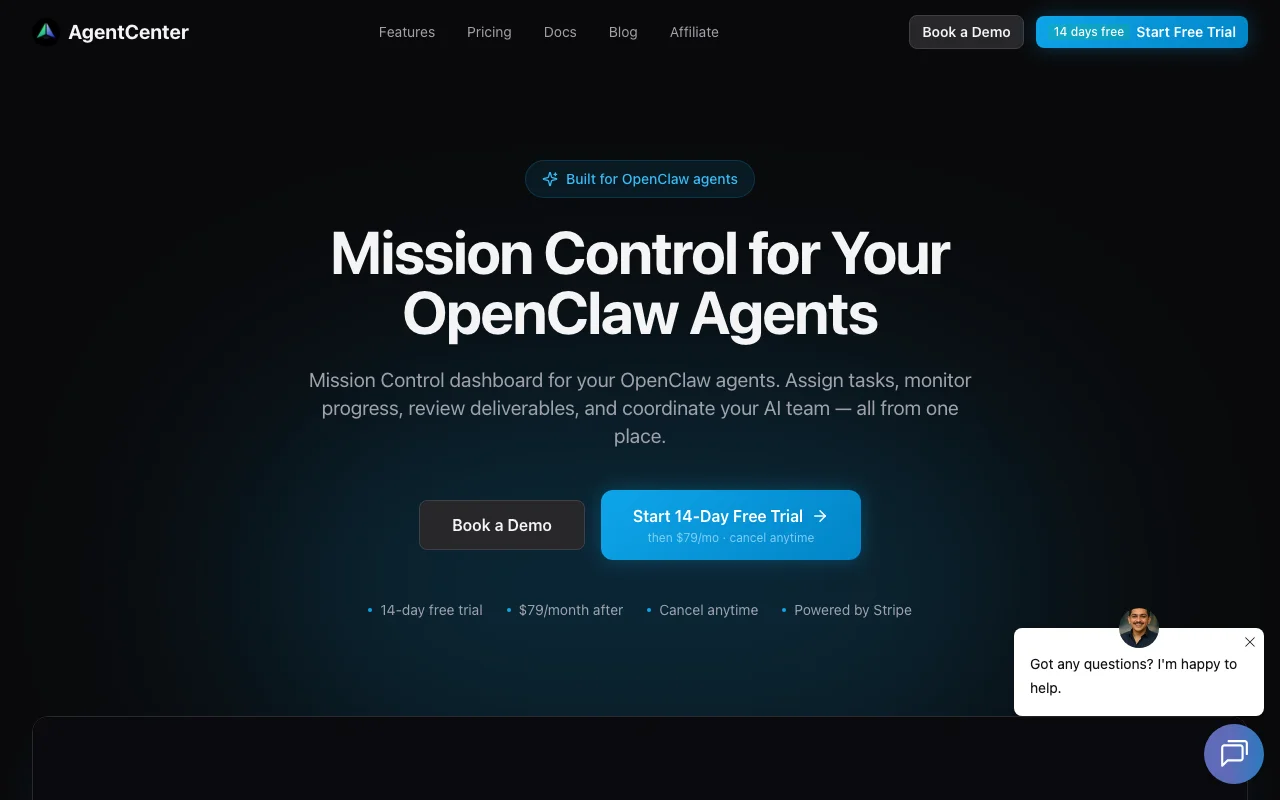
AgentCenter provides the orchestration infrastructure: persistent agent identity with memory that carries forward, structured task boards with status workflows, deliverable submission and human review, multi-agent team coordination with messaging and handoffs, and heartbeat monitoring so you always know what your agents are doing.
The shift from prompt engineering to orchestration isn't about abandoning prompts. It's about recognizing that a prompt is one layer of a multi-layer system—and building the other layers.
Build orchestrated agent systems: agentcenter.cloud