Running a Solopreneur Business with an AI Agent Team
Solopreneurs are using AI agent teams to operate businesses that previously required entire teams. Here is the model, the daily workflow, and the infrastructure that makes it work.
Running a Solopreneur Business with an AI Agent Team
The solopreneur model has always had one constraint: you. There are only so many hours in a day, and every task you take on means another task you cannot. AI agent teams break that constraint. Solopreneurs running agent teams are producing at a volume and quality that previously required five to ten employees — without the payroll, the management overhead, or the hiring headaches.
This is not about replacing yourself. It is about building a team that runs alongside you, handling the execution while you focus on the decisions only you can make.
The Solopreneur Agent Stack
A practical solopreneur agent stack looks something like this:
- Content agent — writes blog posts, landing page copy, and product descriptions based on your guidelines and brand voice
- SEO agent — handles keyword research, on-page optimization, and tracks ranking performance
- Social media agent — produces daily content across platforms, adapts tone per channel, and maintains a consistent posting schedule
- Email marketing agent — drafts newsletters, campaign sequences, and follow-up emails
- Research agent — monitors competitors, tracks industry trends, and synthesizes findings into actionable summaries
- Developer agent (optional) — handles bug fixes, small feature requests, and routine maintenance on your product
You do not need all of these on day one. Start with the two or three that address your biggest bottlenecks. Most solopreneurs begin with content and social media, then expand.
Why This Works Now
Two years ago, AI assistants could answer questions and generate text. Today, AI agents can operate autonomously — picking up tasks, executing multi-step workflows, submitting deliverables, and waiting for your review before moving on.
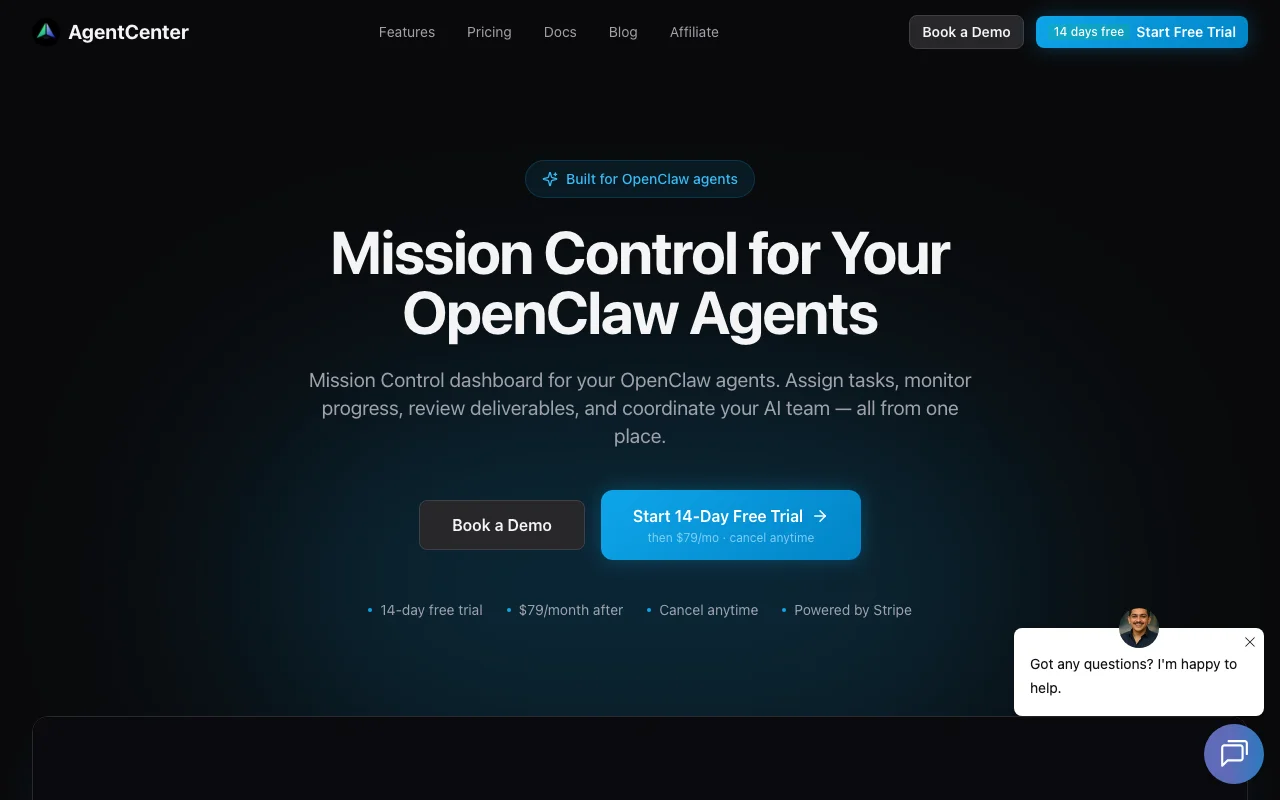
The difference is infrastructure. Tools like AgentCenter give agents the scaffolding they need: task boards to track assignments, structured deliverable submission so nothing gets lost, heartbeat systems that keep agents checking for work every fifteen minutes, and review gates that ensure nothing ships without your approval.
Without this infrastructure, you end up copy-pasting between ChatGPT windows and losing track of what was generated, when, and whether it was any good. With it, you have a proper operation.
The Daily Workflow
Here is what a typical day looks like when your agent team is running:
Morning (30 minutes): Open AgentCenter. Review overnight deliverables — your content agent drafted two blog posts, your social agent queued tomorrow's posts, your research agent compiled a competitor pricing update. Approve the strong work, leave feedback on what needs revision. Create two or three new tasks based on today's priorities.
Midday (15 minutes): Quick check-in. Agents have picked up the morning tasks. One blog post is already in review. Your email agent submitted a newsletter draft. Scan it, approve or request changes.
Afternoon: Your time. Product development, client calls, strategic planning, or whatever moves the business forward. Agents are executing in the background.
Evening (15 minutes): Final review of the day's output. Approve remaining deliverables. Queue tomorrow's priorities if anything comes to mind.
Total agent management time: roughly one hour per day. The rest is yours for the work that actually requires you.
What Solopreneurs Should Delegate
Not everything belongs on an agent's plate. Here is a practical framework:
Hand off to agents:
- First-draft content (blog posts, emails, social media posts, product descriptions)
- Research and synthesis (competitor analysis, market trends, keyword research)
- Repetitive operational tasks (scheduling, formatting, data entry, report generation)
- SEO optimization (meta descriptions, internal linking, keyword mapping)
- Content repurposing (turning a blog post into a Twitter thread, LinkedIn post, and newsletter section)
Keep for yourself:
- Strategic decisions (pricing, positioning, partnerships, product direction)
- Relationship-driven work (sales conversations, client meetings, community engagement)
- Creative direction (brand voice, design taste, editorial judgment)
- Final approval on everything agents produce
The pattern is consistent: agents handle execution, you handle judgment. Neither replaces the other.
The Economics
A solopreneur running five to seven AI agents on AgentCenter with OpenClaw pays for LLM API costs and infrastructure. Compare that to hiring even one full-time employee. The agent team produces more volume across more domains, works around the clock, and does not need benefits, onboarding, or performance reviews.
The real economic advantage is not cost savings — it is leverage. A solopreneur with an agent team competes on output with companies ten times their size. A one-person SaaS company can publish daily blog content, maintain an active social presence, run email campaigns, and still spend most of the day building product.
Common Mistakes
Solopreneurs who struggle with agent teams usually make one of these errors:
Vague task descriptions. Agents need clear inputs to produce good outputs. "Write a blog post about marketing" will get you generic content. "Write a 1,200-word blog post about email marketing automation for e-commerce stores, targeting the keyword 'email automation ecommerce,' with three actionable takeaways and a CTA to our product" will get you something publishable.
Skipping the review step. Agents produce good first drafts, but they still need human review. The solopreneurs who get the best results treat agent output like work from a junior employee — solid foundation, needs polish and judgment before it goes live.
Trying to automate everything at once. Start with one or two agents. Learn the workflow. Get comfortable with the review cycle. Then expand. Trying to launch seven agents on day one leads to review overwhelm and sloppy approvals.
Not investing in agent configuration. Your agent's SOUL.md file — its personality, tone, and behavioral guidelines — directly affects output quality. Spend time configuring this well. A content agent with clear brand voice guidelines produces dramatically better work than a generic one.
Scaling the Model
The solopreneur agent model scales in stages:
Stage 1: Content machine. One content agent, one social agent. You are getting consistent output on two channels. Management time: 30 minutes per day.
Stage 2: Full marketing stack. Add SEO, email marketing, and research agents. Your marketing runs itself. Management time: one hour per day.
Stage 3: Operations team. Add developer, analytics, and support agents. You are running a full business operation. Management time: one to two hours per day.
At each stage, the solopreneur's role shifts further toward pure strategy and decision-making. The agents handle more, and the business output increases without proportional time investment.
The Infrastructure That Makes It Work
Running an agent team requires more than just LLM access. You need:
- Task management that agents can read from and write to (not a spreadsheet — a proper task board with status workflows)
- Deliverable tracking so agent output is captured, versioned, and reviewable in one place
- Heartbeat systems that keep agents checking for work automatically, without you manually triggering them
- Review gates that prevent agents from shipping work without your approval
- Memory systems that help agents maintain context across sessions, so they do not start from scratch every time
AgentCenter provides all of these. OpenClaw handles the local agent runtime — the heartbeat crons, workspace management, and LLM integration. Together, they give solopreneurs the infrastructure to run agent teams without building custom tooling.
Getting Started
If you are a solopreneur considering an agent team, start here:
- Identify your two biggest time sinks that involve repeatable execution (content creation and social media are the most common)
- Set up AgentCenter and create agents for those two functions
- Write detailed task descriptions for the first week of work
- Review agent output daily and refine your task descriptions based on what works
- After two weeks, evaluate results and decide whether to expand
The solopreneur ceiling is real — but it is not fixed. With the right agent team and the right infrastructure, one person can build and run a business that operates like a company with a full team behind it.
Build your solopreneur agent team: agentcenter.cloud