Back to Projects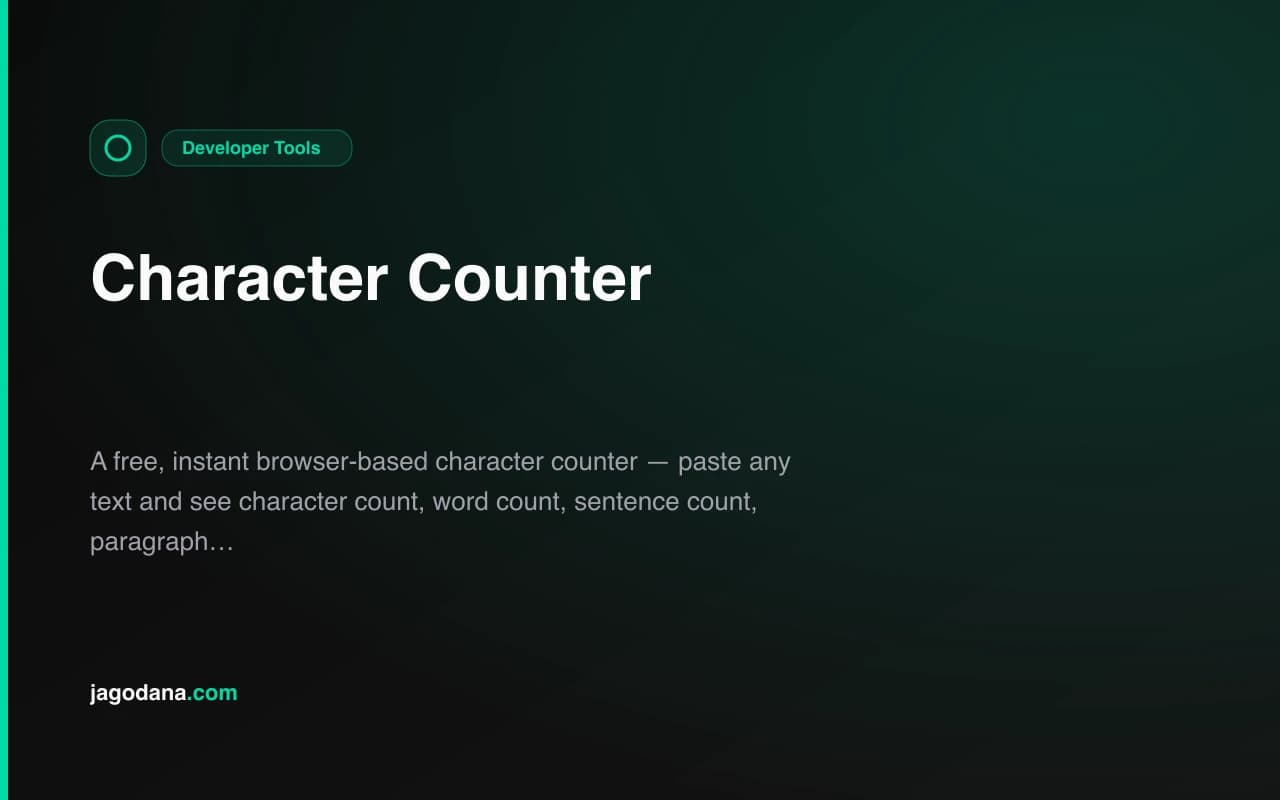
Developer ToolsFeatured
Character Counter
A free, instant browser-based character counter — paste any text and see character count, word count, sentence count, paragraph count, and reading time in real time, with one-click presets for Twitter/X, LinkedIn, SMS, and meta descriptions.
Text ToolsSEOContentDeveloper ToolsNext.jsTypeScript
Start Similar ProjectAbout the Project
Character Counter — Word Count, Sentence & Character Limit Checker
Character Counter is a free, browser-based text analysis tool. Paste or type any text and instantly see character count (with and without spaces), word count, sentence count, paragraph count, line count, and estimated reading time. One-click presets for Twitter/X, LinkedIn, SMS, meta descriptions, and more show a visual progress bar so you know exactly how far you are from any limit. No signup, no server calls — everything runs in the browser.
The Problem
"How many characters does this tweet have?" "Will this meta description get cut off?" "Is this SMS going to split into two segments?"
These three questions come up dozens of times a week for content writers, SEO specialists, developers, and marketers — and every time, it means either eyeballing it, pasting into a platform editor, or opening a random website that's full of ads and doesn't update in real time.
The friction is small. The cumulative cost is not.
A wrong character count on a meta description means the title gets truncated in Google results. A tweet that's two characters over means copy-pasting into Twitter just to discover the problem. An SMS that's 170 characters means two segments instead of one — and two charges per recipient.
How It Works
1. Paste or Type
Drop any text into the input area. The counter updates in real time as you type, with no submit button and no delay. Characters, words, sentences, paragraphs, and reading time all update simultaneously.
2. Select a Limit Preset
Click one of the preset buttons to overlay a character limit on top of your text:
- Twitter / X — 280 characters
- SMS (GSM) — 160 characters (single segment)
- Meta Description — 155 characters
- Meta Title — 60 characters
- LinkedIn Post — 3,000 characters
- Instagram Caption — 2,200 characters
- YouTube Title — 100 characters
- Email Subject — 50 characters
A progress bar appears showing how much of the limit is used. When you go over, the bar turns red and shows how many characters over you are.
3. Read the Full Stats
Six stat cards update in real time:
- Characters — total character count including spaces
- No Spaces — character count excluding whitespace
- Words — total word count (whitespace-delimited)
- Sentences — count of sentence-ending punctuation groups
- Paragraphs — double-newline separated blocks of text
- Reading Time — estimated reading time at 200 wpm
4. Copy or Clear
Copy the entire text to clipboard with one click, or clear the input to start fresh. Both actions are available directly in the text area — no scrolling required.
Key Features
- Real-time counting — all stats update as you type, no submit button
- 8 limit presets — Twitter/X, SMS, Meta Description, Meta Title, LinkedIn, Instagram, YouTube, Email Subject
- Visual progress bar — color-coded: green → amber (≥90%) → red (over limit)
- Remaining / over count — exact characters remaining or over the limit
- 6 stat types — characters, chars without spaces, words, sentences, paragraphs, reading time
- Copy to clipboard — one-click copy of all text
- Fully client-side — no data sent to any server, works offline
- No signup required — open and start counting immediately
- Dark mode support — matches your system preference or manual toggle
Technical Implementation
Core Technologies
- Next.js 16 with App Router and TypeScript strict mode
- Tailwind CSS v4 with OKLCH color tokens and blue/indigo brand palette
- shadcn/ui (new-york style) for accessible button and card components
- Framer Motion for smooth preset panel transitions
- Pure browser-side logic — zero external API dependencies
Counting Algorithm
All counting logic is implemented as a single pure function — analyzeText(text: string): TextStats — with no side effects and no external dependencies:
- Characters:
text.length— the raw string length including spaces and newlines - Chars without spaces:
text.replace(/\s/g, "").length— removes all whitespace - Words: splits on
\s+after trimming — empty strings excluded - Sentences: regex match on
[.!?]+clusters — consecutive punctuation counts as one sentence end - Paragraphs: splits on
\n\s*\n— double newlines (standard prose paragraph separator) - Lines: splits on
\n, filters empty lines - Reading time:
Math.ceil((words / 200) * 60)seconds — formatted asXm Ys
The useMemo hook ensures the function only re-runs when the text input changes.
Limit Preset Architecture
Presets are defined as a static typed array of { label, limit, color } objects. The active preset is tracked with a single useState call. The progress bar width is computed as Math.min(100, (chars / limit) * 100)% — capped at 100% so the bar never overflows the container. Remaining characters use the same formula with different sign handling for the over-limit state.
Architecture
CharacterCounterTool— main client component with all state and computationanalyzeText()— pure function, unit-testable, no DOM accessPRESETS— typed const array, compile-time validatedStatCard— reusable stat display sub-componentformatReadingTime()— pure time formatting utility
Use Cases
SEO Meta Tag Optimization
The most common use case. Paste a meta description or page title and see immediately whether it fits within Google's display limits (155 chars for description, 60 chars for title). The instant visual feedback replaces the trial-and-error of refreshing the Google Search Console preview.
Social Media Copywriting
Twitter/X's 280-character limit is tight enough that going two characters over means a rewrite. The real-time counter with the Twitter preset eliminates the "paste into Twitter to check" workflow. Writers can draft and edit directly, knowing exactly how many characters remain.
SMS Campaign Validation
SMS billing is per-segment. An 161-character message costs twice as much per recipient as a 160-character message — at scale, that compounds fast. The SMS (160 char) preset shows the exact breaking point. Non-Latin characters (emoji, accented letters) cut the single-segment limit to 70 — something most SMS dashboards don't make obvious until after you've sent the campaign.
Content Length Estimation
For editors, writers, and content managers, reading time is the most useful stat. Paste a draft article, check the reading time, and know whether it fits the "5-minute read" target without counting words manually.
Email Subject Line Testing
Email platforms often truncate subject lines at 50–60 characters in mobile inboxes. The Email Subject preset (50 chars) gives a conservative safe zone. Subjects that fit under 50 characters display in full on virtually every device.
Accessibility and Plain Language Work
Word count and sentence count are useful signals for readability. Short sentences (under 20 words) and modest paragraph lengths are accessibility best practices. Character Counter makes these counts visible as you write — no separate readability tool needed.
Why Character Counter?
vs. Counting in the Platform Editor
Twitter, LinkedIn, and most CMS editors show a character count only while you're composing in their editor. That means you can't check a draft you're writing elsewhere, and you can't check multiple limits at once. Character Counter works on any text, any limit, before you open any platform.
vs. Other Online Counters
Most online character counters are slow (no real-time updates), cluttered with ads, and don't offer multiple limit presets. Character Counter updates on every keystroke, has no ads, and offers 8 presets in a single click.
vs. Word Processors
Word processors (Google Docs, Word) show word count, but character counting requires going into a menu. Limit checking against platform-specific thresholds requires a formula or a macro. Character Counter is faster for the specific task of checking character limits.
Results
Character Counter removes the four most common points of friction in text-length workflows:
- No platform-hop to check length — paste once, read all stats
- No guessing at limits — 8 presets with one-click application
- No over-limit surprises — color-coded bar and character count update in real time
- No privacy risk — text stays in the browser, nothing reaches any server
Try it now: character-counter.tools.jagodana.com
The Challenge
The client needed a robust developer tools solution that could scale with their growing user base while maintaining a seamless user experience across all devices.
The Solution
We built a modern application using Text Tools and SEO, focusing on performance, accessibility, and a delightful user experience.
Project Details
Category
Developer Tools
Technologies
Text Tools,SEO,Content,Developer Tools,Next.js,TypeScript
Date
July 2026
Related Projects
More work in Developer Tools