Back to Projects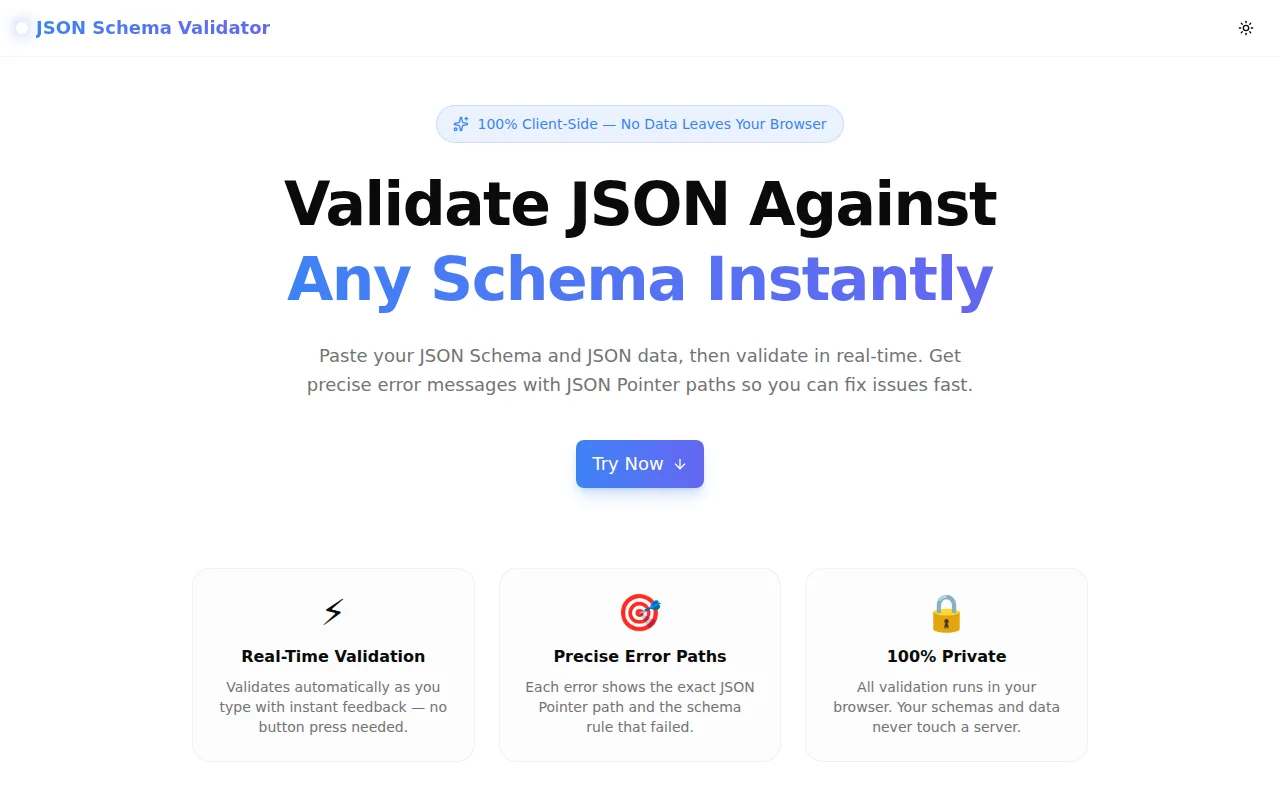
Developer ToolsFeatured
JSON Schema Validator
Validate any JSON document against a JSON Schema (draft-7) in real-time, right in your browser. Instant error messages with JSON Pointer paths, format validators, and built-in sample schemas. No server, no sign-up, 100% private.
JSONJSON SchemaValidationDeveloper ToolsAPITypeScriptNext.js
Start Similar ProjectAbout the Project
JSON Schema Validator — Validate JSON Against Any Schema Instantly
JSON Schema Validator is a free, browser-based tool that lets you validate any JSON document against a JSON Schema (draft-7) in real-time. Paste your schema on the left, your data on the right, and see instant validation results with precise JSON Pointer error paths. No server, no account, no data ever leaves your browser.
The Problem
API integration breaks at the boundary. A webhook payload arrives with an unexpected null. A config file has a missing required key. A form submission contains a string where an integer was expected. The validator rejects it, your code throws, and you spend 20 minutes grepping through logs to find which field failed.
JSON Schema is the industry standard for defining and validating JSON structures. Every major ecosystem uses it: OpenAPI / Swagger, Kubernetes, MongoDB, AWS CloudFormation, Ajv, Pydantic. But testing a schema locally has always required setting up a Node.js project, installing Ajv, writing a test harness, and running it.
That's overkill for a quick sanity-check. Developers need a scratchpad — somewhere to drop a schema, drop some data, and get a yes/no verdict in under five seconds.
How It Works
1. Dual-Panel Editor
Two text areas sit side by side. The left panel holds your JSON Schema; the right panel holds the JSON data you want to validate. Both support free-form editing with monospace fonts and syntax-aware layout.
Validation runs automatically 400ms after you stop typing — no button press needed. The data panel border turns green on success and red on failure, giving you a visual signal before you even read the results.
2. Detailed Error Messages
When validation fails, you get a list of every error, not just the first one. Each error shows three pieces of information:
- JSON Pointer path — the exact location in the data where the failure occurred, using RFC 6901 notation (
/user/email,/products/0/price) - Human-readable message — a plain English description of what went wrong ("must have required property 'id'", "must be >= 0")
- Schema keyword — the keyword that triggered the error (
required,minimum,pattern,format), so you can find the rule in your schema
3. Format Validators
Draft-7 defines formats that go beyond basic types. This tool validates all standard formats: email, uri, date, date-time, time, uuid, ipv4, ipv6, hostname, json-pointer. A string that passes "type": "string" will still fail if its "format": "email" value isn't a valid email address.
4. Built-In Sample Schemas
Three sample schemas let you see the tool in action immediately:
- User Object — validates an account record with id, name, email, age, and role enum
- Product Catalog — validates an array of products with SKU pattern matching and price constraints
- API Config — validates a configuration object with a
oneOfunion type for bearer and basic authentication
Each sample includes pre-filled data so you can load it, modify a value to introduce an error, and see exactly how the error reporting works.
5. Prettify and Reset
A "Prettify" button formats the content of either panel with consistent 2-space indentation. A "Reset" button returns both panels to the default sample. Both keep your workflow fast — clean up messy input without leaving the tool.
Key Features
- Auto-validation — validates 400ms after typing stops, no button required
- All errors at once —
allErrors: truemode shows every violation, not just the first - JSON Pointer paths — RFC 6901 notation pinpoints the exact failing location
- Format validation — email, uri, date, uuid, ipv4, ipv6, and more
- $ref and $defs support — reference definitions within the same schema
- allOf / anyOf / oneOf / not — composition keywords fully supported
- if / then / else — conditional schema application
- Built-in samples — three real-world schemas to get started instantly
- Prettify — format JSON in either panel with one click
- Keyword reference — expandable quick-reference for common schema keywords
- 100% client-side — AJV runs entirely in the browser; no data is sent anywhere
- No account required — open the URL and validate immediately
Technical Implementation
Core Technologies
- Next.js 16 with App Router
- TypeScript in strict mode
- AJV 8 — the fastest JSON Schema validator for JavaScript
- ajv-formats — standard format validators (email, uri, date, uuid, etc.)
- Tailwind CSS v4 with OKLCH color tokens
- shadcn/ui — accessible UI components
- Framer Motion — smooth result panel transitions
- Sonner — toast notifications for copy and reset actions
Architecture
The validator compiles the JSON Schema on each change using ajv.compile(). AJV is initialized once at module level with allErrors: true and formats registered. Input changes trigger a 400ms debounced revalidation using useEffect and useRef.
Schema and data parse errors are caught separately before AJV runs, so the tool distinguishes between "your schema has a JSON syntax error" (orange), "your data has a JSON syntax error" (orange), and "your data fails the schema" (red).
Error objects from AJV are mapped to a typed ValidationError interface with path, message, and keyword fields. This structured representation drives the error list UI.
Use Cases
API Development
You're implementing a POST endpoint that accepts a JSON body. Write the schema first, paste a few example payloads, and verify each one validates before writing a single line of handler code. Catch the edge cases — null values, missing optional fields, strings where numbers were expected — before they hit production.
OpenAPI / Swagger Contract Testing
OpenAPI request and response bodies are JSON Schemas. Paste the schema from your spec, paste a real API response, and confirm the response matches the contract. Great for catching schema drift when a backend team changes a response shape without updating the OpenAPI spec.
Config File Validation
Configuration files for CI pipelines, infrastructure-as-code tools, or internal services are often JSON (or YAML that gets deserialized to JSON). Define a schema for your config format and validate every config file against it before deployment.
Webhook Payload Testing
Third-party webhooks don't always match their documentation. Paste the documented schema, paste the actual payload your handler received, and see exactly what differs. No more guessing which field is missing or which type is wrong.
Learning JSON Schema
JSON Schema's composition keywords — allOf, anyOf, oneOf, conditional if/then/else, $ref — can be confusing to learn from documentation alone. This tool gives you an interactive sandbox: write a schema, write data that should pass and data that should fail, and see the validation results instantly. The expandable keyword reference at the bottom of the page is a useful companion.
Team Reviews and Documentation
When reviewing a PR that adds or changes a JSON Schema, paste the schema and a representative payload into the validator to confirm the schema behaves as intended. Faster than setting up a local test environment.
Why JSON Schema Validator?
vs. curl + ajv locally
Setting up AJV in a Node.js project, writing a validation script, and running it takes minutes. This tool is 5 seconds: open URL, paste, done.
vs. jsonschemavalidator.net and similar online tools
This tool uses AJV 8 (the same library used in production by millions of Node.js apps) running directly in your browser. No round-trips to a server. No privacy risk with sensitive payloads. No rate limits. No ads.
vs. Postman Schema Validation
Postman's schema validation requires an account, a collection, and a test script. This tool requires nothing — just a browser tab.
Results
JSON Schema Validator removes the friction from draft-7 validation:
- Zero setup — no npm install, no project, no config
- Complete error reports — every failure at once, with paths
- Same library, same results — AJV 8 matches what your production validators use
- Private by design — sensitive schemas and payloads never leave the browser
Try it now: json-schema-validator.tools.jagodana.com
The Challenge
The client needed a robust developer tools solution that could scale with their growing user base while maintaining a seamless user experience across all devices.
The Solution
We built a modern application using JSON and JSON Schema, focusing on performance, accessibility, and a delightful user experience.
Project Details
Category
Developer Tools
Technologies
JSON,JSON Schema,Validation,Developer Tools,API,TypeScript,Next.js
Date
May 2026
Related Projects
More work in Developer Tools