Introducing Dependency Tree Visualizer: See Your Package Dependencies Like Never Before
Transform your package.json into an interactive, security-aware tree visualization. Identify vulnerabilities, deprecated packages, and dependency relationships—all in your browser.
Introducing Dependency Tree Visualizer: See Your Package Dependencies Like Never Before
If you've ever tried to understand the dependency tree of a large Node.js project, you know the struggle. Running npm list gives you a wall of text. The package.json only shows top-level deps. And good luck spotting security vulnerabilities or deprecated packages in the mix.
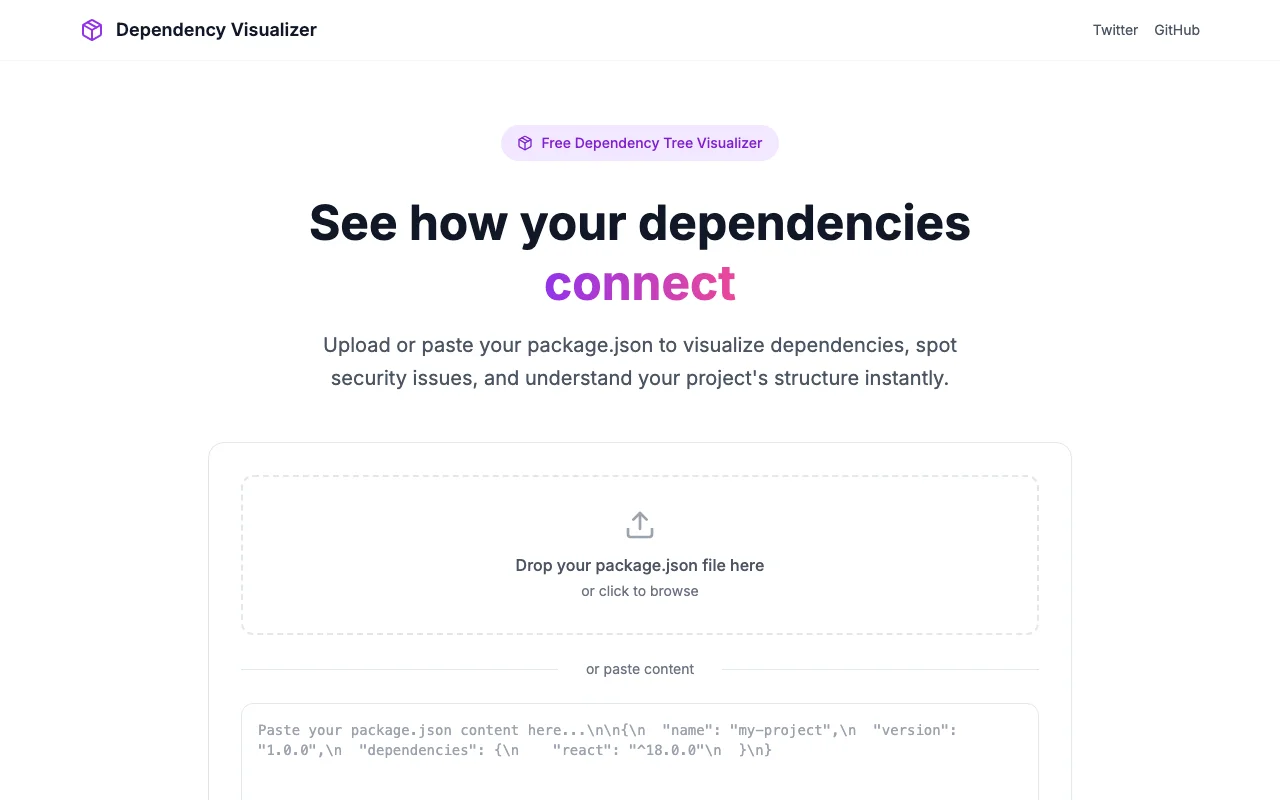
That's why we built Dependency Tree Visualizer—an interactive, browser-based tool that transforms your package.json into a beautiful, security-aware tree that reveals everything you need to know about your dependencies.
The Hidden Complexity Problem
Modern JavaScript projects are dependency juggernauts. A typical React app can easily have:
- 1,000+ packages in node_modules
- Complex nested relationships 5+ levels deep
- Multiple versions of the same package
- Security vulnerabilities hiding in transitive deps
- Deprecated packages slowly rotting your codebase
Traditional tools show you lists. We show you the relationships, risks, and structure that actually matter.
Enter Dependency Tree Visualizer
Dependency Tree Visualizer is a free, privacy-first tool that turns your package.json into an interactive map of your project's dependencies:
- 🌳 Interactive tree visualization with expand/collapse navigation
- 🚨 Security vulnerability detection for known CVEs
- ⚠️ Deprecated package warnings (moment, request, etc.)
- 📊 Dependency statistics and health metrics
- 🎨 Color-coded types (production, dev, peer, optional)
- 🔒 100% browser-based - your data never leaves your device
Key Features That Matter
🌳 Visual Tree Navigation
Stop squinting at text output. Our interactive tree lets you:
- Click to expand/collapse branches
- See dependency relationships at any depth
- Navigate complex trees with ease
- Focus on specific branches without distraction
Each dependency is color-coded:
- 🔵 Production (Blue) - Runtime dependencies
- 🟣 Development (Purple) - Dev-only tools
- 🟢 Peer (Green) - Expected by consuming projects
- ⚫ Optional (Gray) - Nice-to-have packages
🚨 Security Intelligence
Don't ship vulnerabilities. Our analyzer checks for:
- Known CVEs in popular packages
- Deprecated packages that need replacement
- Version conflicts and wildcard warnings
- Security severity scores
See issues highlighted in red (critical) and yellow (warnings) right in the tree.
📊 Instant Statistics
Get project insights at a glance:
📦 Total Dependencies: 847
   🔵 Production: 23
   🟣 Development: 156
   🚨 Security Issues: 3
   ⚠️ Deprecated: 7
Perfect for audits, reports, and quick project health checks.
🔒 Privacy by Design
Your package.json contains sensitive information—internal package names, versions, architectural decisions. That's why:
- Everything runs in your browser via JavaScript
- No uploads to our servers ever
- No data logging or analytics on your deps
- Works offline once loaded
- Safe for proprietary projects
Real-World Use Cases
🔍 Security Auditing
Before deploying that critical update:
- Upload your package.json
- Scan for red vulnerability markers
- Prioritize fixes by severity
- Document security posture for compliance
📈 Technical Debt Assessment
Understanding what needs updating:
- Spot deprecated packages like moment.js
- Find duplicate dependencies inflating bundle size
- Plan migration strategies with visual context
- Communicate complexity to stakeholders
👥 Team Onboarding
New developers joining the project:
- Visual project structure beats reading lists
- Understand architectural decisions at a glance
- See dependency relationships and why they exist
- Learn codebase complexity before diving in
🏢 Enterprise Compliance
For teams that need dependency governance:
- Audit third-party packages for license compliance
- Track security posture across projects
- Document dependency decisions with visual evidence
- Share reports with security teams
How It Works
Dead simple. No signups. No configuration:
- 📁 Upload your package.json file (or paste the content)
- 🔍 Analyze - We parse dependencies in milliseconds
- 🌳 Explore - Click through the interactive tree
- 📋 Export - Save insights or share with your team
Built for Modern Development
Dependency Tree Visualizer uses cutting-edge web technology:
- Next.js 16 with App Router for performance
- TypeScript for reliability
- Tailwind CSS for responsive design
- Radix UI for accessibility
- Framer Motion for smooth interactions
- WebAssembly for fast parsing of large files
Try It Right Now
Ready to see your dependencies in a whole new light?
👉 Launch Dependency Tree Visualizer
Upload your package.json and discover:
- Hidden security vulnerabilities
- Deprecated packages slowing you down
- Complex dependency relationships
- Opportunities to reduce bundle size
Open Source & Community
We believe in transparency. The entire project is open source:
Found a bug? Have a feature request? Want to contribute? We'd love to hear from you.
What Developers Are Saying
"Finally! A tool that shows me my dependency tree the way I think about it. Found 3 vulnerable packages I didn't even know we were using." — Sarah K., Senior Developer
"The color coding is brilliant. I can instantly see production vs dev dependencies. This is going in our standard workflow." — Mike T., Tech Lead
Coming Next
We're just getting started. Planned features include:
- 📊 Bundle size analysis - See which deps are bloating your app
- 🔄 Update recommendations - Smart suggestions for package updates
- 📈 Historical tracking - Watch dependency health over time
- ⚙️ CI/CD integration - Automated dependency audits in your pipeline
- 🌐 Network graph view - Alternative visualization for complex projects
Have ideas? Let us know what you'd like to see!
Start Visualizing Today
Stop guessing what's in your node_modules. Stop shipping vulnerable dependencies. Stop letting deprecated packages accumulate technical debt.
Try Dependency Tree Visualizer and see your project dependencies the way they were meant to be seen—as a beautiful, interactive, security-aware tree.
Your future self (and your security team) will thank you.
Follow @Dharmendra_Jago for updates on new tools and features.