Morse Code Translator — Free Online Text to Morse Code Converter with Audio
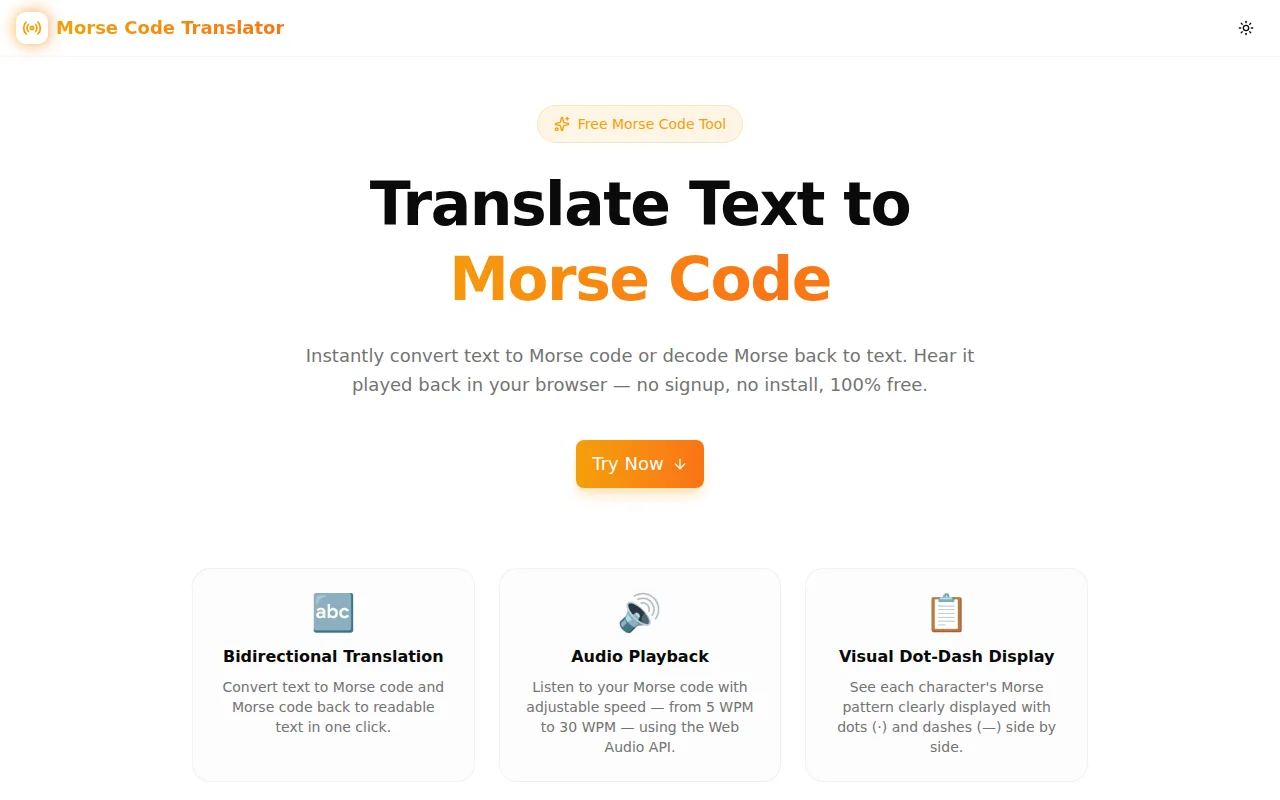
Instantly convert text to Morse code or decode Morse back to text. Hear it played back in your browser with adjustable WPM speed. 100% client-side, no login required.
Morse Code Translator — Free Online Text to Morse Code Converter with Audio
Morse code has been around since the 1830s. It predates everything we now call "the internet" by about 150 years. And yet, converting text to Morse code is still something people need to do — and the tools available to do it are mostly relics from the early 2000s.
Morse Code Translator is a free, modern, fully browser-based tool that converts text to Morse code and back, plays it back as audio, and shows you the character-by-character breakdown — with no server, no login, and no ads in the way.
What Is Morse Code?
Morse code is a character encoding system that represents letters, digits, and punctuation as sequences of short signals (dots ·) and long signals (dashes —). Developed by Samuel Morse and Alfred Vail in the 1830s, it was the backbone of telegraphic communication for over a century.
Today it remains in active use in:
- Amateur (ham) radio — CW (continuous wave) Morse is still a major mode of operation
- Aviation — VOR navigation beacons still broadcast their identifier in Morse
- Military and emergency communications — used where voice is impractical or unreliable
- Accessibility — Morse code is an input method for people with severe motor impairments
- Education and scouting — standard content in many scouting curricula
And of course, it appears constantly in puzzle games, escape rooms, ARGs, and coding challenges.
How Do You Convert Text to Morse Code?
Converting text to Morse code follows a simple rule: each character maps to a unique combination of dots and dashes, letters are separated by single spaces, and words are separated by a forward slash (/) or a longer pause.
The Standard International Morse Alphabet
| Letter | Morse | Letter | Morse |
|--------|-------|--------|-------|
| A | .- | N | -. |
| B | -... | O | --- |
| C | -.-. | P | .--. |
| D | -.. | Q | --.- |
| E | . | R | .-. |
| F | ..-. | S | ... |
| G | --. | T | - |
| H | .... | U | ..- |
| I | .. | V | ...- |
| J | .--- | W | .-- |
| K | -.- | X | -..- |
| L | .-.. | Y | -.-- |
| M | -- | Z | --.. |
Digits: 0 = -----, 1 = .----, ..., 9 = ----.
How to Use the Morse Code Translator (Step by Step)
Step 1: Open morse-code-translator.tools.jagodana.com
Step 2: Select Text → Morse to encode, or Morse → Text to decode
Step 3: Type or paste your content into the input field
Step 4: The output appears instantly below
Step 5: (Optional) Click Play Audio to hear the Morse code at your chosen speed
Step 6: Click Copy to send the result to your clipboard
The entire workflow takes under 10 seconds.
How Does the Audio Playback Work?
The audio is generated entirely in the browser using the Web Audio API — no external server, no audio file downloads.
When you click Play:
- An oscillator node is created at 700 Hz (the standard CW Morse tone frequency)
- Each dot plays for
1.2 / wpmseconds; each dash plays for three times that - Gain is ramped in and out to avoid clicks at the start and end of each element
- The inter-element gap (between dots and dashes within one character) is one dot-length
- The inter-character gap is three dot-lengths; the inter-word gap is seven
This matches the timing standard used in amateur radio, so practice on this tool transfers directly to real CW operation.
What Is WPM in Morse Code?
WPM stands for Words Per Minute. In Morse code, speed is measured using the word "PARIS" as the benchmark — "PARIS" in Morse code contains exactly 50 elements (dots, dashes, and gaps), which is considered the standard word length.
At 5 WPM, each dot is 240ms long. At 20 WPM, each dot is 60ms. At 30 WPM — near the top of our slider — each dot is 40ms. Experienced CW operators often work at 25–35 WPM.
Learning progression:
- 5 WPM — complete beginner; reading each element individually
- 10 WPM — comfortable with the alphabet; starting to hear characters
- 15 WPM — typical goal for first licence; characters become automatic
- 20–25 WPM — comfortable DX (long-distance) contact speed
- 30 WPM — advanced; words come in as chunks
How Do You Decode Morse Code?
To decode Morse code back to text using this tool:
- Switch to the Morse → Text tab
- Paste your Morse code into the input field
- Separate individual letters with single spaces
- Separate words with a forward slash (
/) or three or more spaces
Example: .... . .-.. .-.. --- / .-- --- .-. .-.. -.. decodes to "HELLO WORLD"
The character breakdown panel shows each code alongside its decoded letter, making it easy to verify individual characters.
Can This Tool Help Me Learn Morse Code?
Yes — the character breakdown panel is specifically designed for learning. As you type familiar words in encode mode, each letter is shown next to its Morse pattern. Repeated exposure builds recognition.
Combined with the audio playback, the approach mirrors the Koch method used in amateur radio training: you hear the sound, you see the pattern, and eventually the character becomes automatic.
For structured learning, start with a few letters (E, T, A, N, I, M are the most common and have the shortest codes) and build from there.
Is This Morse Code Translator Free?
Yes. Completely free. No account, no login, no download, no paywall.
The tool is one of 365 free developer and designer tools being built by Jagodana — one new tool every day for a year. All tools are open source, hosted on Vercel, and designed to solve small but real productivity problems.
Who Is This Tool For?
- Ham radio operators practicing CW before an exam or on-air contacts
- Scouts and educators teaching communication history or emergency signalling
- Developers verifying Morse code in games, puzzles, or escape room designs
- Puzzle and ARG creators generating and testing Morse sequences
- Curious people who just want to know what "SOS" sounds like
- Accessibility researchers evaluating Morse as an alternative input method
Technical Notes
The translator supports all 26 letters (A–Z, case-insensitive), digits 0–9, and 19 punctuation characters including . , ? ! / ( ) & : ; = + - _ " $ and @.
Unsupported characters are shown as ? in the output. All processing happens in the browser — your text is never sent to any server.
Try it now: morse-code-translator.tools.jagodana.com
Source code: github.com/Jagodana-Studio-Private-Limited/morse-code-translator