Back to Projects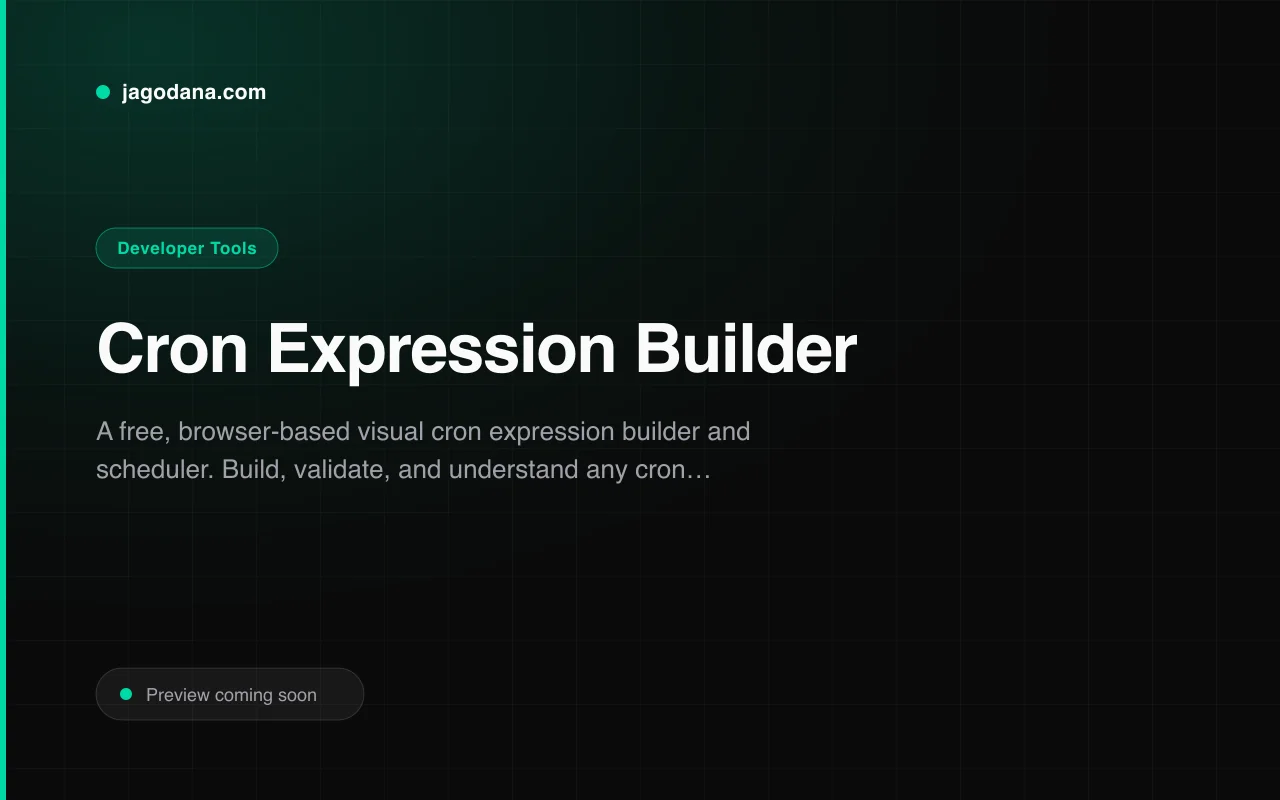
Developer ToolsFeatured
Cron Expression Builder
A free, browser-based visual cron expression builder and scheduler. Build, validate, and understand any cron expression instantly — see plain-English descriptions and preview the next 5 run times without memorising the syntax.
CronCron ExpressionSchedulerDevOpsDeveloper ToolsNext.jsTypeScript
Start Similar ProjectAbout the Project
Cron Expression Builder — Visual Cron Scheduler Without the Syntax Headaches
Cron Expression Builder is a free, browser-based tool for developers, DevOps engineers, and system administrators who need to create or validate cron schedules quickly — without memorising the five-field cron syntax or counting on external documentation.
The Problem
Cron expressions are everywhere. GitHub Actions uses them. AWS EventBridge uses them. Kubernetes CronJobs use them. Heroku Scheduler uses them. Linux crontab has used them for decades.
They're also confusing to write from memory.
The format is minute hour day-of-month month day-of-week, and the edge cases pile up fast:
- Is Monday
0or1? (It's1in POSIX cron,0is Sunday) - Does
*/5in the minute field mean "every 5 minutes from midnight" or "every 5 minutes from the current minute"? - When
day-of-monthandday-of-weekare both non-*, does the job fire when either matches, or both? - What's the difference between
0 0 * * 0and0 0 * * SUN?
Every developer who works with scheduled jobs has opened a cron cheat sheet at least once this week. The answers are always findable, but finding them takes time — and context switching to look something up mid-task is friction that adds up.
How It Works
1. Type or Paste an Expression
Enter any 5-field cron expression in the text bar at the top. The tool immediately validates the syntax and parses it into its component fields. If the expression is valid, a green badge appears. Invalid expressions show a red badge with no further output, avoiding misleading descriptions.
2. Edit Fields Individually
Below the text bar, five individual input fields let you edit each cron component independently: Minute, Hour, Day of Month, Month, and Day of Week. Changing any field updates the expression bar in real time. This is useful when you know two or three fields and need to construct the rest.
All standard cron operators work:
*— any value5— exact value1,3,5— list of values1-5— range*/5— step (every 5th value)1-10/2— step within a range (every 2nd value from 1 to 10)
Month and day-of-week fields also accept named aliases: JAN–DEC and SUN–SAT.
3. Read the Plain-English Description
Every valid expression is instantly translated into a human-readable schedule. 0 9 * * 1-5 becomes "At 09:00, Monday through Friday". */15 * * * * becomes "Every 15 minutes". The descriptions handle common patterns (exact time, every N units, ranges, lists) and compose them into clear English without being verbose.
4. Preview the Next Run Times
A panel below the description shows the next 5 scheduled execution times, calculated forward from the current moment. This is the fastest way to verify a complex schedule before deploying it:
- Confirm your "weekday mornings" cron actually skips the weekend
- Verify that a monthly job on the "1st of the month" fires on the right day
- Catch off-by-one errors in ranges (e.g.,
1-5vs0-4)
The calculation iterates minute-by-minute through time (up to one year ahead) and matches against the parsed field sets — the same logic most cron daemons use.
5. Use Quick Presets
A grid of 13 preset buttons covers the most common recurring schedules. Click any preset to load it into the editor instantly:
| Expression | Label |
|---|---|
| * * * * * | Every minute |
| */5 * * * * | Every 5 minutes |
| */15 * * * * | Every 15 minutes |
| */30 * * * * | Every 30 minutes |
| 0 * * * * | Every hour |
| 0 */6 * * * | Every 6 hours |
| 0 0 * * * | Daily at midnight |
| 0 12 * * * | Daily at noon |
| 0 9 * * 1-5 | Weekdays at 9 AM |
| 0 9 * * 1 | Mondays at 9 AM |
| 0 0 * * 0 | Weekly (Sun midnight) |
| 0 0 1 * * | 1st of month midnight |
| 0 0 1 1 * | Every year (Jan 1) |
6. Copy the Expression
A single click copies the validated expression to the clipboard. The copy button is disabled when the expression is invalid, preventing accidental deployment of broken schedules.
Key Features
- Visual field editor — edit each cron component independently, all operators supported
- Real-time validation — instant valid/invalid feedback as you type
- Plain-English descriptions — every valid expression translated to readable prose
- Next-run preview — see the next 5 execution times to verify the schedule
- 13 preset schedules — one-click presets for the most common patterns
- Quick reference card —
*,,,-,/operators explained inline - Named aliases —
JAN–DECandSUN–SATare resolved automatically - Copy to clipboard — one-click copy; disabled on invalid expressions
- No signup required — open the URL and start building
- Client-side only — all logic runs in your browser, nothing sent to a server
- Dark/light mode — adapts to your system or manual toggle
Technical Implementation
Core Technologies
- Next.js 16 with App Router
- TypeScript in strict mode
- Tailwind CSS v4 with OKLCH color tokens
- shadcn/ui (new-york style) for accessible UI components
- Framer Motion for entrance animations
- Sonner for toast notifications
Cron Parsing Architecture
The parser handles all standard cron operators via a recursive field parser:
- Alias resolution — replaces named month/DOW aliases with their numeric equivalents before parsing
- List expansion — splits comma-separated segments and processes each independently
- Step parsing — handles
range/stepsyntax, expanding to the set of matching values - Range parsing — expands
start-endranges into full value sets - Validation — checks every resolved value against the field's allowed range (min/max)
The result is a Set<number> for each field. The next-run calculator intersects these sets against each successive minute from now forward, stopping when it has found N matching timestamps or exceeded a one-year horizon.
Description Generation
The description function handles the most common patterns explicitly (exact time, every-N-minutes, weekday-range, etc.) before falling back to a compose-and-join approach that builds a sentence from per-field descriptions. Special-cased common expressions (* * * * *, 0 0 * * *, etc.) get idiomatic phrases rather than constructed ones.
Use Cases
DevOps & CI/CD
Writing a GitHub Actions scheduled workflow? Configuring a Kubernetes CronJob? Set the schedule in plain English first ("every weekday at 7 AM"), pick the matching preset, then copy the expression into your YAML. The next-run preview confirms the job won't fire unexpectedly during off-hours.
AWS & Cloud Schedulers
AWS EventBridge Scheduler, AWS Lambda cron triggers, and GCP Cloud Scheduler all accept standard 5-field cron expressions. Use the builder to construct and validate the expression before pasting it into the console — avoiding the "I'll fix it if it fires wrong" approach to production schedules.
Heroku Scheduler & PaaS Tools
Many PaaS platforms accept cron expressions for recurring tasks (database backups, report generation, cache warming). The builder's preset library covers the most common Heroku Scheduler use cases, and the next-run preview confirms the schedule before it goes live.
Linux Crontab
Adding a new entry to /etc/crontab or a user crontab? Build the expression here, verify it fires at the right time with the next-run preview, then paste it in. The quick reference card keeps the syntax rules visible without switching tabs.
Data Pipelines & ETL
Scheduling nightly ETL jobs, hourly data syncs, or monthly reporting runs? The visual editor makes it easy to build expressions like "2 AM on the 1st and 15th of every month" (0 2 1,15 * *) without making arithmetic mistakes.
Why Cron Expression Builder?
vs. Memorising the Syntax
- No lookup required — field labels tell you what each position means
- Named aliases supported —
MON,WED,FRIare more readable than1,3,5 - Next-run preview — verify before deploying, not after
vs. A Text Search or Cheat Sheet
- Interactive — change one field and see the full expression update
- Validates as you type — no waiting until deploy to find out the expression is wrong
- Generates descriptions — a cheat sheet tells you what
*/5means; this tool tells you what your entire expression means
vs. Other Online Cron Tools
- No ads, no signup, no tracking beyond Google Analytics for aggregate usage
- Next-run preview included — most tools stop at description
- Runs entirely client-side — your expression data never leaves your browser
Try it now: cron-expression-builder.tools.jagodana.com
The Challenge
The client needed a robust developer tools solution that could scale with their growing user base while maintaining a seamless user experience across all devices.
The Solution
We built a modern application using Cron and Cron Expression, focusing on performance, accessibility, and a delightful user experience.
Project Details
Category
Developer Tools
Technologies
Cron,Cron Expression,Scheduler,DevOps,Developer Tools,Next.js,TypeScript
Date
July 2026
Related Projects
More work in Developer Tools