Free Online Base64 Encoder & Decoder: Encode and Decode Instantly in Your Browser
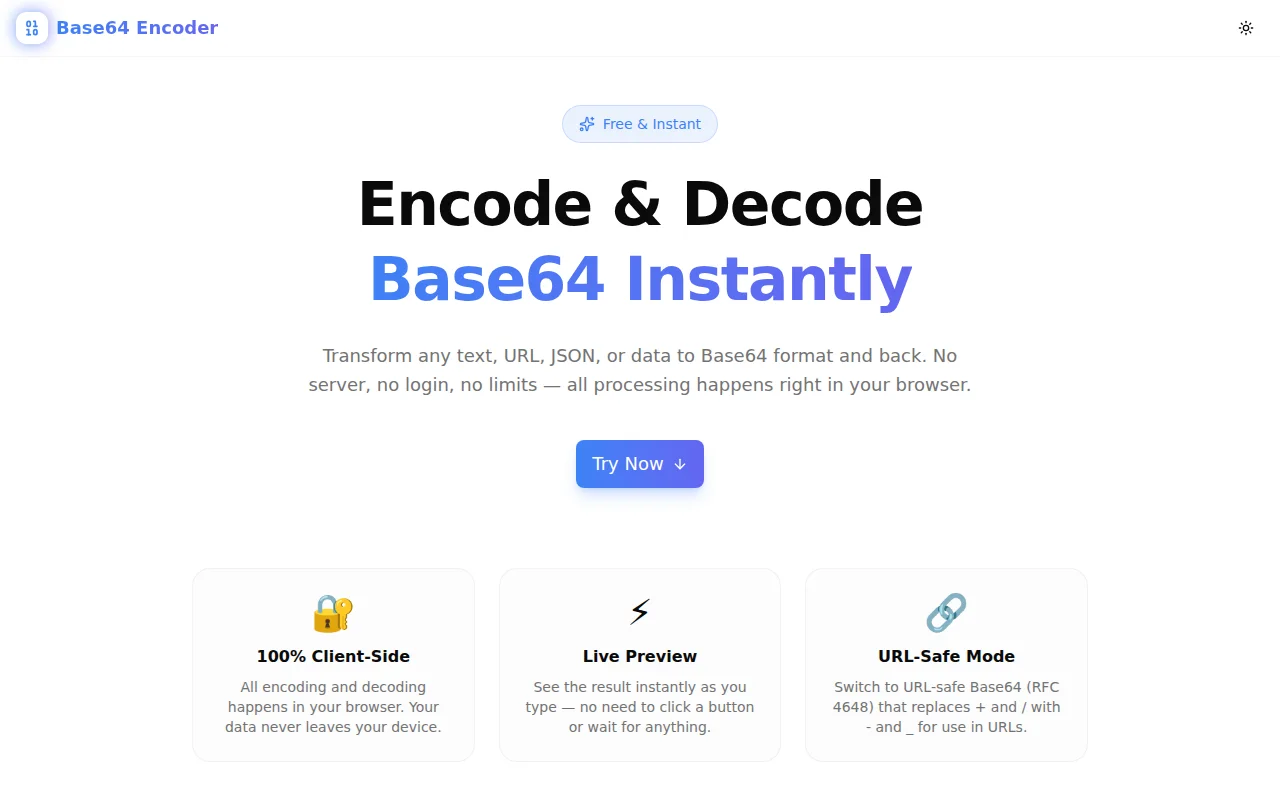
Encode any text, URL, or JSON to Base64 and decode Base64 strings back to plain text — instantly, 100% client-side, with URL-safe mode. No signup, no server, no risk.
Free Online Base64 Encoder & Decoder: Encode and Decode Instantly in Your Browser
You need to decode an API response, inspect a JWT payload, or encode a credential for an HTTP header. The right way to do it is with a Base64 tool that is fast, private, and works both ways. The Base64 Encoder at Jagodana does exactly that — and everything happens in your browser, so your data never leaves your device.
What Is Base64 Encoding?
Base64 is a binary-to-text encoding scheme that represents any binary data using 64 printable ASCII characters: A–Z, a–z, 0–9, +, and /. A padding character = is appended when the input length is not divisible by three.
The result is always safe to transmit over text-based protocols — email, HTTP headers, JSON fields, HTML attributes — because it contains no special characters, no control characters, and no non-ASCII bytes.
Base64 is not encryption. Anyone can decode a Base64 string without any key. Its purpose is encoding, not confidentiality.
How Do I Encode Text to Base64 Online?
Encoding text to Base64 takes three steps:
- Go to base64-encoder.tools.jagodana.com
- Paste or type your text in the input field — the Base64 output appears instantly as you type
- Click Copy to copy the result to your clipboard
That is it. No button press, no page reload. The output updates live as you type.
How Do I Decode a Base64 String Back to Text?
- Click the Decode tab in the tool
- Paste your Base64 string in the input field
- Read the decoded text in the output panel
If the input is an invalid Base64 string — wrong characters, bad padding — the output shows a clear error message instead of returning garbage.
What Is URL-Safe Base64 and When Should I Use It?
Standard Base64 uses + and /, both of which are special characters in URLs. If you pass standard Base64 in a query string, a URL path, or a filename, those characters need to be percent-encoded as %2B and %2F — making the string longer and harder to read.
URL-safe Base64 (defined in RFC 4648 Section 5) solves this by replacing:
+with-/with_
The result is a string that travels safely through URLs, filenames, and HTTP headers without any escaping. JWT tokens, for example, use URL-safe Base64 for all three segments.
Toggle the URL-safe switch in the tool to switch between standard and URL-safe variants. The output updates immediately.
Is My Data Safe When Using an Online Base64 Tool?
With most online tools, no — they send your input to their server, where it may be logged.
With this tool, yes — all encoding and decoding runs entirely in your browser using the standard Web APIs btoa() and atob(). Nothing is transmitted to any server. Your text is private.
This matters when you are encoding or decoding:
- API keys and tokens
- Passwords and credentials
- JWT payloads with user data
- Internal system identifiers
What Does the = Padding at the End of Base64 Mean?
Base64 encodes three bytes at a time into four characters. If your input length is not divisible by three, padding characters (=) are added to make the output length a multiple of four:
- No padding: input length is divisible by 3
- One
=: input had 1 extra byte after the last group - Two
==: input had 2 extra bytes after the last group
URL-safe Base64 often omits padding entirely (it can be inferred from the string length). The decoder handles both padded and unpadded input automatically.
How Do I Verify That My Encoded Value Is Correct?
Use the Swap button in the tool. After encoding, clicking Swap loads the encoded output back into the input and switches to Decode mode. If the decoded result matches your original text, the encoding is correct.
This round-trip check is the fastest way to catch encoding issues without writing any code.
What Characters Are Valid in a Base64 String?
| Variant | Valid Characters | Padding | |---|---|---| | Standard Base64 | A–Z, a–z, 0–9, +, / | = | | URL-safe Base64 | A–Z, a–z, 0–9, -, _ | = (often omitted) |
Any other character in a Base64 string is invalid. The decoder will report an error.
Common Base64 Use Cases for Developers
HTTP Basic Authentication
The Authorization: Basic header encodes username:password in Base64:
Authorization: Basic dXNlcjpwYXNzd29yZA==
Decode dXNlcjpwYXNzd29yZA== to read user:password. Useful for debugging auth headers in Postman logs, proxy captures, or server logs.
JWT Token Inspection
A JWT token is three URL-safe Base64url segments separated by dots:
eyJhbGciOiJIUzI1NiIsInR5cCI6IkpXVCJ9.eyJzdWIiOiIxMjM0NTY3ODkwIn0.signature
Decode the first segment to see the header ({"alg":"HS256","typ":"JWT"}). Decode the second to see the payload claims. No secret key needed — the signature segment is not needed for inspection.
Data URI Embedding
Embed small assets inline in HTML or CSS using Base64:
background-image: url("data:image/svg+xml;base64,PHN2Zy...");Encode the SVG source, prepend data:image/svg+xml;base64,, and paste directly into your stylesheet. Eliminates one HTTP request for small icons.
API Payload Fields
Some REST APIs Base64-encode binary fields (image thumbnails, file content, cryptographic hashes) so they travel safely in JSON without binary escaping. Decode the field value to inspect the content.
Environment Variables with Binary Values
Deployment platforms sometimes require secrets (certificates, keys, tokens with special characters) to be stored as Base64 in environment variables. Encode the raw value before storing; decode when reading.
How Long Does Base64 Encoding Make a String?
Base64 output is approximately 4/3 the size of the input — every 3 bytes of input produce 4 characters of output. The tool shows the exact character count and output-to-input ratio in the footer of the output panel.
For a 100-byte input:
- Output: ~136 characters (including padding)
- Overhead: ~33%
This overhead is the trade-off for text-safe transmission. For large binary files, dedicated binary encoding or compression is more appropriate.
Base64 Encoder vs. Other Tools
vs. Running base64 in the Terminal
The command-line base64 utility is available on macOS and Linux, but:
- Not available on Windows without extra tools
- The
-nflag to suppress the trailing newline is easy to forget (adding a newline changes the output) - Switching to a terminal window breaks flow for a quick lookup
The browser tool is faster for one-off tasks and works on any OS without installation.
vs. Writing Code
A one-liner in Python (import base64; print(base64.b64encode(b"text").decode())) or Node (Buffer.from("text").toString("base64")) works but requires:
- A terminal
- A language runtime
- Remembering the exact API
- Handling the encoding of the string (bytes vs. string)
For a spot-check or a one-time conversion, the browser tool is faster.
vs. Other Online Base64 Tools
Most online Base64 tools:
- Send your input to their server (privacy risk)
- Show intrusive ads
- Lack URL-safe mode
- Do not show clear error messages for invalid input
This tool processes everything locally, has no ads, supports URL-safe mode, and shows clear error states.
Try It
base64-encoder.tools.jagodana.com — free, instant, and 100% private.
Built in under an hour as part of the 365 Tools Challenge: one free developer tool, every day.